
If your DACA renewal is still pending when the calendar year ends, the pending case does not automatically expire or become denied on December 31. USCIS currently continues to accept and process DACA renewal requests and related employment authorization applications. Current DACA grants and related Employment Authorization Documents, or EADs, remain valid until their stated expiration dates unless USCIS individually terminates them.
For most renewal applicants, the date that matters most is the expiration date on the current DACA approval notice and work permit. If your current DACA and EAD expire before USCIS approves the renewal, you should not assume that a pending filing keeps your DACA-based employment authorization active. DACA-based EADs use category C33, which is not included in the USCIS list of categories that receive an automatic EAD extension based on a pending renewal.
If you are in New Jersey and your DACA renewal remains pending, review your current approval notice, EAD, receipt notices, USCIS account, mailing address, and any agency messages. You should also consider whether there have been changes in your personal or immigration history that could affect the renewal.
USCIS DACA information:
For information about DACA representation in New Jersey:
https://www.susanscheerimmigrationlaw.com/new-jersey-daca-lawyer/
December 31 does not create a separate DACA expiration date. Your current DACA and EAD expiration dates control whether those documents remain valid.
See what our clients have to say about our law firm and the people who are a part of it.
- David Amaya Portillo
- Mubarak Ahmad
Client Testimonials
A Pending DACA Renewal Does Not End on December 31 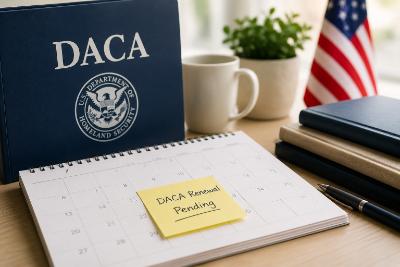
A DACA renewal can remain pending from one calendar year into the next. There is no general USCIS rule requiring a renewal to be approved or denied before December 31 simply because a new year is beginning.
For example, if you filed a DACA renewal in October and it remains pending in January, the change in calendar year does not by itself mean that USCIS denied the case or that the filing expired. USCIS currently states that it continues to accept and process DACA renewal requests and accompanying applications for employment authorization.
Start by reviewing your Form I-797 receipt notices. Confirm that USCIS accepted the Form I-821D and Form I-765 and that the receipt numbers match the filings you expected. Keep copies of the forms, supporting documents, filing confirmation, and any proof of delivery if the case was mailed.
You can also review your case through your USCIS online account and the agency case-status tools. If USCIS issues a notice, request, or appointment, follow the instructions and deadline stated in that notice.
USCIS Form I-821D information:
Your Current DACA and EAD Expiration Dates Matter Most
DACA is granted for a limited period, and the related EAD also has an expiration date. If your renewal remains pending near year-end, compare the dates on your current DACA approval notice and EAD with the receipt date for the renewal.
USCIS states that current grants of DACA and related EADs remain valid until they expire unless they are individually terminated. A pending renewal does not change the printed expiration date on an existing DACA grant or work permit.
This distinction can affect your ability to work. A pending DACA renewal receipt should not be treated as proof that an expired DACA-based EAD remains valid. DACA employment authorization is issued under category C33, and C33 is not listed among the categories that receive an automatic EAD extension based only on a timely filed renewal.
If your employer asks for updated work authorization documentation, review the documents you actually have and the current USCIS rules that apply to them. Do not assume that a receipt notice gives you employment authorization after the prior DACA-based EAD expires.
USCIS employment authorization guidance:
When Should You File a DACA Renewal?
USCIS strongly encourages DACA recipients to file renewal requests between 120 and 150 days before the expiration date on the current Form I-797 DACA approval notice. Filing during that window can reduce the risk of a gap between the expiration of the current DACA period and the decision on the renewal.
USCIS also states that filing earlier than 150 days before the current DACA expiration date will not result in a faster decision. Current Form I-821D instructions warn that USCIS may reject a request filed more than 150 days before the current deferred action period expires and instruct the applicant to refile closer to the expiration date.
A practical approach is to place the 150-day and 120-day dates on your calendar well before your current DACA expires. This gives you time to review forms, gather documents, address changes in your history, and file within the USCIS-recommended period.
What If Your DACA Renewal Has Been Pending for Months?
A renewal that takes longer than expected is not automatically a denial. USCIS states that it adjudicates the majority of DACA renewal requests within 120 days, but individual cases can take longer.
If your renewal has been pending for an extended period, review each part of the case carefully:
- Check the case status for both Form I-821D and Form I-765.
- Confirm that USCIS has your current mailing address.
- Review your USCIS online account for notices, messages, or updates.
- Confirm that you did not miss a biometrics appointment, Request for Evidence, or other deadline.
- Keep copies of every USCIS notice and every response you submitted.
- Check the current USCIS processing-time information for Form I-821D.
- Use the USCIS case-inquiry options when your case is eligible for an inquiry under the agency’s current processing-time system.
USCIS processing times:
https://egov.uscis.gov/processing-times/
A related firm resource explains why immigration processing times can vary by form, category, and office:
https://www.susanscheerimmigrationlaw.com/how-long-are-immigration-processing-times-new-jersey-2026/
Our Legal Team
At The Scheer Immigration Law Group in Morristown, NJ, we focus exclusively on immigration law, handling everything from visas and green cards to deportation defense.
With over 25 years of experience, our team is known for delivering knowledgeable, effective representation to clients across the U.S.


Can You Ask USCIS to Expedite a Pending DACA Renewal?
USCIS may consider an expedite request on a case-by-case basis. The decision is discretionary, and USCIS generally requires documentation supporting the request.
Current USCIS expedite criteria can include:
- Severe financial loss to a person or company, when the urgent need was not caused by a failure to file or respond on time.
- An emergency or urgent humanitarian situation.
- Certain nonprofit organization requests that further cultural or social interests of the United States.
- Government interests involving matters such as public safety, national interest, or national security.
- Clear USCIS error.
Meeting one of these categories does not mean that USCIS will expedite the case. The agency reviews the facts and supporting evidence.
If a work permit is close to expiring, a general statement that you need to keep working may not be enough. Depending on the facts, supporting records could include an employer letter, documentation of job loss or another severe financial consequence, medical documentation, government correspondence, or evidence showing a USCIS error.
USCIS expedite guidance:
https://www.uscis.gov/forms/filing-guidance/expedite-requests
Does a Pending Renewal Continue Deferred Action Protection?
DACA is deferred action. It is not lawful immigration status, permanent residence, or citizenship. USCIS describes deferred action as a discretionary decision to defer removal for a specified period.
If your current DACA remains unexpired while the renewal is pending, that existing grant remains valid through its stated expiration date unless USCIS terminates it. If your DACA grant expires before the renewal is approved, you should not assume that the pending request provides the same protection as an active DACA grant.
A delayed renewal is also a reason to review any changes in your history that may affect the case. Examples can include:
- A recent arrest, criminal charge, or conviction.
- A prior or new removal order or immigration court matter.
- A departure from the United States.
- New immigration violations or encounters with immigration authorities.
- Information that was not included in a prior DACA filing.
These facts do not automatically mean that USCIS will deny a renewal. They can change the legal analysis, so a careful review can be useful before you submit a response, travel, or make another immigration filing.
What About Travel While a DACA Renewal Is Pending?
A pending DACA renewal is not permission to travel outside the United States. A DACA work permit is also not, by itself, a travel document.
USCIS states that a person must first receive DACA before requesting advance parole based on DACA. A DACA recipient who plans to travel outside the United States generally needs to request and receive the appropriate advance parole document before departure. Travel without the required authorization can create serious immigration consequences.
International travel can also raise separate questions about prior unlawful presence, removal history, admissibility, prior entries, and other parts of your immigration record. Advance parole does not remove every possible immigration issue.
Before making international travel plans, review the specific facts of your case and the current travel rules that apply to you.
Firm travel and work permit information:
https://www.susanscheerimmigrationlaw.com/travel-and-work-permit/
USCIS DACA travel information:
Could You Have Another Immigration Option?
A delayed DACA renewal can be a useful time to review whether DACA is your only possible immigration option.
DACA does not provide lawful immigration status and does not automatically create a path to a green card or U.S. citizenship. Some DACA recipients may qualify for another form of immigration relief based on facts that developed after the original DACA request or facts that were never fully reviewed.
Issues worth discussing with an immigration attorney can include:
- Marriage to a U.S. citizen or lawful permanent resident.
- Other qualifying family relationships.
- Employment-based immigration possibilities.
- Victim-based immigration options.
- Prior entries, departures, or advance parole travel.
- Immigration court history or prior removal orders.
- Humanitarian immigration options.
Eligibility for another immigration benefit depends on the complete facts. Marriage, employment, years of residence in the United States, or DACA history alone do not automatically create eligibility for permanent residence.
Plan Before Your Current DACA and EAD Expire
If your DACA renewal is still pending near the end of the year, focus on the dates and documents that control your current situation. December 31 is not a special DACA deadline unless it is also the expiration date printed on one of your documents.
Review your current DACA approval notice, EAD, Form I-821D and Form I-765 receipt notices, USCIS account, mailing address, and any pending agency requests. If your current work permit is close to expiring, address the issue before the expiration date rather than assuming that a pending renewal automatically extends your employment authorization.
The Scheer Immigration Law Group assists DACA recipients throughout New Jersey with renewal questions, processing delays, work authorization concerns, travel issues, and reviews of other possible immigration options. The firm focuses exclusively on immigration law and serves clients from its Morristown, New Jersey office.
To discuss a pending DACA renewal, call (973) 532-5330 or contact the firm:
https://www.susanscheerimmigrationlaw.com/contact-us/
This article is for informational purposes only and is not legal advice. Immigration rules, agency policies, and court decisions can change. Speak with an immigration attorney about your specific situation.